01
Force
力量
Painting as an event rather than an image.
Gao’s compositions emerge through pressure, movement, collision and release. What remains on the surface is not simply an image, but the trace of forces taking form.
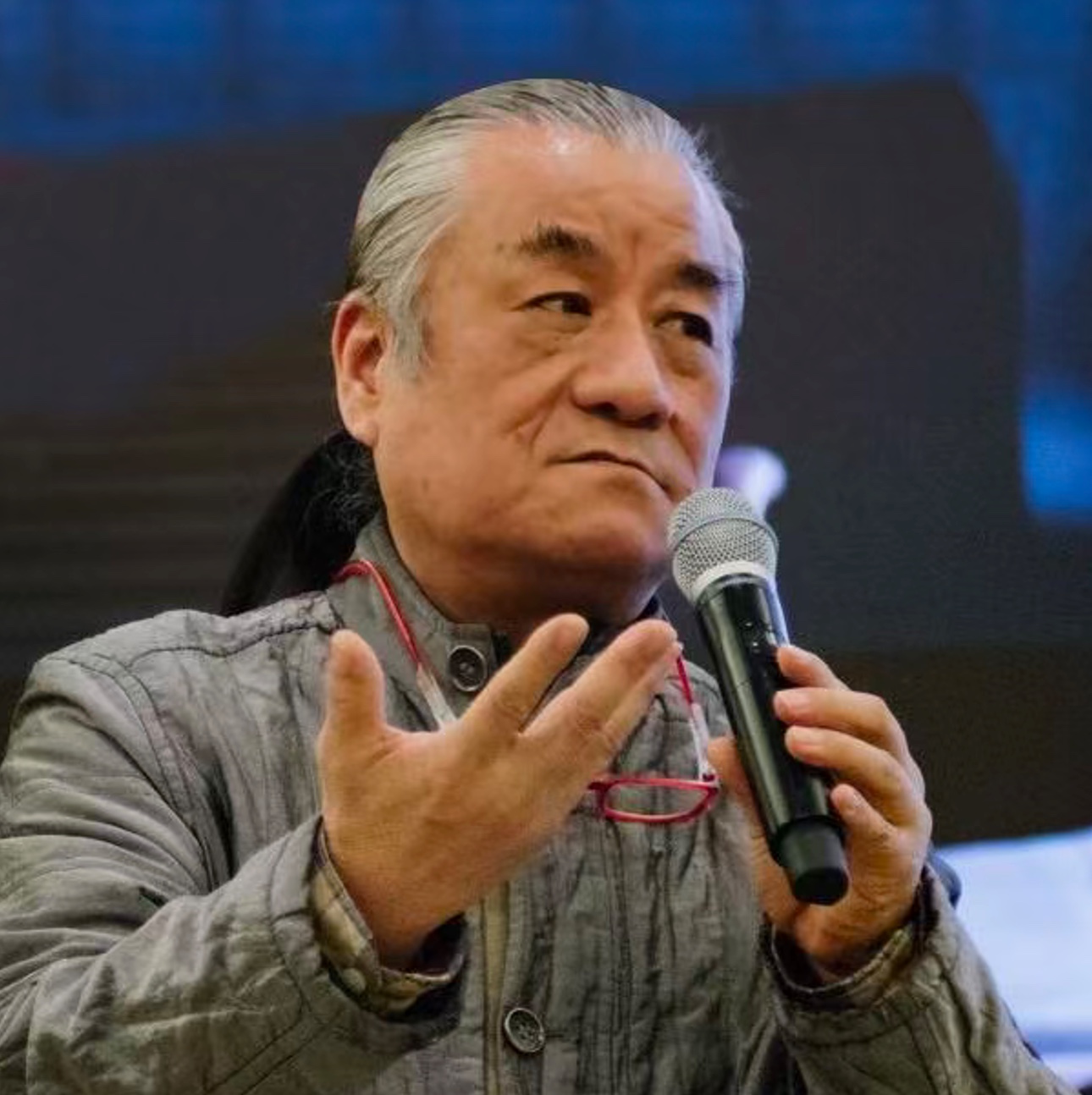
Gao Quanqiang (b. 1955, China) is a contemporary ink artist whose practice brings the discipline and material sensitivity of Chinese ink painting into dialogue with contemporary abstraction. He graduated from the China Academy of Art and later joined the institution as a member of its teaching faculty, where he was engaged in professional painting education.
After relocating to the United States, Gao continued to develop his practice through an increasingly experimental approach to ink, color, gesture and pictorial structure. Rather than treating ink as a fixed traditional medium, he explores it as a responsive material capable of movement, accumulation, interruption and transformation.
His work has been exhibited in the United States, including presentations in Rhode Island and California, with exhibitions in Hollywood and Beverly Hills.
Gao’s paintings often allow ink to merge with color, line to expand into mass, color to fracture monochrome fields, and isolated marks to disrupt the surface. Brushwork moves beyond representation and becomes a record of pressure, speed, rhythm and physical action. Dense fields of ink, exposed paper, layered washes and saturated color create a dynamic tension between control and spontaneity, structure and dissolution.
Across Gao Quanqiang’s shifting visual registers, a consistent internal logic remains: force becomes gesture, gesture generates tension, and tension gives rise to form. These four ideas offer a way into the work without reducing it to a single style or motif.
Gao’s compositions emerge through pressure, movement, collision and release. What remains on the surface is not simply an image, but the trace of forces taking form.
Line, stroke and wash register speed, weight, direction and interruption. Gesture is not used merely to describe form—it becomes form itself.
Ink spreads, color intrudes, forms collide and empty space resists. Gao allows chance to enter the work while retaining a precise sense of when to intervene—and when to stop.
Mountains, water, rock, fire and landscape may be sensed in Gao’s paintings, yet rarely appear as subjects. What emerges instead is the energy through which forms gather, fracture and transform.
Artwork titles are shown in English with the original Chinese title retained beneath. Dates, dimensions and media are standardized from the artist’s supplied portfolio PDF. Dimensions are presented in both metric and U.S. customary units for gallery review.
Ningbo Museum of Art, Ningbo, China · May 26–June 16, 2022.
Qiantang Bay Art Museum, Hangzhou, China · November 3–December 30, 2021.
Wu Changshuo Memorial Hall, Anji, Zhejiang, China · November 2020.
Hangzhou Peace International Convention & Exhibition Center, Hangzhou, China.
Additional presentations include Hollywood and Beverly Hills, as noted in the artist’s supplied biography.